
If you’re thinking about starting therapy in the Salt Lake City area, you probably have questions. Who do they help? What kind of therapy do they offer? How much does it cost? What actually happens in the first session?
This guide provides key details about Phoenix Rebellion Therapy. Use it to decide if this therapy is right for you.
What Phoenix Rebellion Therapy Is
Phoenix Rebellion Therapy is a mental health practice. It has offices in Murray and Kaysville. They serve people throughout the Salt Lake Valley and the Wasatch Front.
They work with:
- Adults
- Teens and children
- Couples
- Families
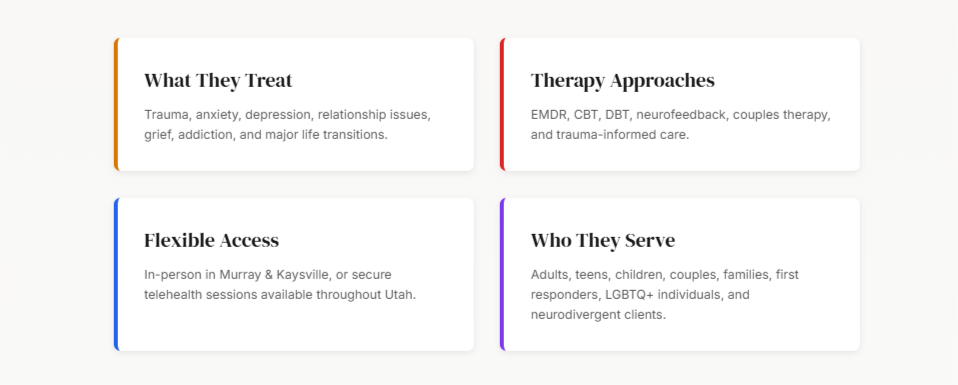
People come in with various issues, like trauma, anxiety, and depression. They also face relationship problems, grief, addiction, and major life changes.
The practice says that its method is “human first and clinically sound.” That means they want to be kind and respectful while also using methods that have been shown to work.
Services They Offer
Phoenix Rebellion Therapy provides several types of counseling so care can be matched to each person or family:
- Individual therapy for adults, teens, and children
- Couples and marriage counseling
- Family therapy
- Group therapy at times for specific topics, such as trauma or skills-building
Therapists customize treatment to each client’s goals, history, and preferences, instead of employing a universal plan.
Issues They Commonly Help With
Clients seek support at Phoenix Rebellion Therapy for a wide range of concerns, including:
- Anxiety and stress
- Depression and low mood
- Trauma and PTSD, including childhood trauma, abuse, accidents, medical trauma, violence, and first-responder exposure
- Grief and loss
- Addiction and habit change
- Relationship issues, such as communication problems, trust, conflict, or feeling disconnected
- Domestic violence recovery
- Emotional regulation and coping skills
- Life transitions, work–life balance, faith transitions, and identity questions
Therapists at the practice see these problems as normal reactions to stress and life events, not as failures on the part of the person.

How Therapy Is Done: Approaches and Modalities
Phoenix Rebellion Therapy uses a variety of trauma-informed and evidence-based methods. Your therapist will explain to you which ones they think are best for you and why.
Common modalities include:
- EMDR (Eye Movement Desensitization and Reprocessing) for trauma and PTSD
- Neurofeedback therapy (real-time brainwave training) to support regulation, attention, and mood
- Accelerated Resolution Therapy (ART) for trauma and distressing memories
- CBT (Cognitive Behavioral Therapy) to work with thoughts, behaviors, and mood
- DBT (Dialectical Behavior Therapy) skills for emotion regulation and distress tolerance
- ACT (Acceptance and Commitment Therapy) and mindfulness-based approaches
- Gottman Method and Emotionally Focused Therapy (EFT) for couples
- Attachment-based work and traditional talk therapy
- Anger management and coping-skills training
You do not need to know which modality you “should” choose ahead of time. A key part of early sessions is figuring that out together.
The Therapists and Their Perspectives
There are licensed clinical social workers (LCSWs), clinical mental health counselors (CMHCs), associate clinicians, and therapists in supervised practice on the clinical team at Phoenix Rebellion Therapy. They learn about trauma, mood disorders, relationships, addiction, and more.
Each therapist has a slightly different focus, but they all have the same themes of compassion, awareness of the nervous system, and respect for each client’s story.
On Trauma and Safety
Therapists at the practice think that trauma is stored in the nervous system as well as in memory. Juliann, LCSW, a clinician, says that trauma is less about what happened and more about how the body and mind reacted to it. In this view, therapy is all about safety, giving people power, and teaching the nervous system that the danger is over.
Another therapist, Westin, MSW-I, says that trauma-informed care starts with “What happened to you?” instead of “What’s wrong with you?” The goal of that change is to lessen shame and make room for healing.
On Anxiety and Stress
When it comes to anxiety, clinicians describe it as a natural survival response that can become overactive. Brett Blanchard, CMHC, highlights that therapy can help people retrain their nervous system so they can respond to stress instead of reacting automatically.
James Healey, LCSW, adds that while avoidance can offer short-term relief, it often strengthens anxiety over time. Approaches like CBT, ACT, and mindfulness are used to help people face fears in small, manageable steps so the brain can relearn that certain situations are not actually dangerous.
On Depression and Low Mood
Depression is a mix of biology, life experiences, and thought patterns, not a sign of weakness. Jessica Hale, LCSW, emphasizes small, consistent actions and cognitive strategies to boost mood and motivation. Medical support may also be important.
Bailey, LCSW, explains that therapy helps people recognize and challenge the negative filters linked to depression. It allows them to replace these with balanced, evidence-based views.
On Relationships and Attachment
Several clinicians concentrate on attachment and interpersonal relationships. Kim M., LCSW, talks about how early attachment experiences affect adult relationships and how safe, stable therapeutic relationships can help people learn how to connect in healthier ways.
Kimberly P., CMHC, says that conflict itself is not the main problem in couples work. What matters more is how couples fix things after a fight. Couples therapy at the practice is based on evidence and focuses on how to talk to each other and be emotionally responsive instead of “winning” an argument.
On Emotional Regulation and Coping Skills
Therapists at Phoenix Rebellion Therapy often teach people how to deal with strong feelings in a practical way. Jessica Hale, LCSW, says that emotional regulation is the ability to feel things without getting too upset or shutting down.
Steven Bristow, CMHC, says that you can train your nervous system. Grounding, paced breathing, and mindful awareness are some of the skills used because research shows they lower physical stress responses and make people stronger emotionally over time.
On Growth, Resilience, and Change
The practice’s clinicians view resilience as a skill, not a fixed trait. Josie Martindal, ACMHC, highlights supportive relationships, coping skills, and meaning-making. She sees therapy as a space to intentionally develop these strengths.
Jeffrey, CMHC, notes that seeking therapy often shows a desire for deeper self-understanding and intentional change. It isn’t just a sign that “something is wrong.”
Who They Serve
Phoenix Rebellion Therapy works with a broad and diverse client base, including:
- Adults, teens, and children
- Couples and families, including blended families and co-parenting situations
- First responders, firefighters, police, military members, and veterans
- LGBTQ+ individuals and families
- Neurodivergent clients, such as those with ADHD or autism
- People navigating faith transitions, kink-aware care, sexual health concerns, shame, or identity questions
- Anyone facing trauma, mood disorders, addiction, grief, or significant life stress
The practice focuses on helping those who feel misunderstood, stigmatized, or ignored in other places.
Insurance, Cost, and Payment
Phoenix Rebellion Therapy is in network with many major insurance plans, including Tricare for military and veteran families.
You can:
- Use an insurance checker on their website, or
- Call the office to have staff verify your coverage
Before you book, the team will confirm your benefits so you know what to expect.
With insurance, clients usually pay their copay, deductible, or coinsurance at each visit.
The practice has direct-pay options for people who pay with cash or their own money. You can find out about current rates by calling (385) 231-8387. They say they work with a variety of budgets and are open about their fees. The practice notes that there are no extra fees and that the costs are made clear from the start.
How to Get Started
Beginning services is meant to be straightforward and low-pressure.
Reach out
You can call (385) 231-8387 or fill out the contact form on their website. You’ll discuss why you’re coming in, what you want to achieve, and any preferences. This includes the gender of your therapist, whether you prefer in-person or online sessions. And if you’re interested in EMDR, neurofeedback, LGBTQ+-affirming, or faith-sensitive care.
Get matched
The intake team reviews this information and recommends a clinician whose background and schedule fit your needs. Most people are offered an appointment within a few days to two weeks, depending on availability and match.
Complete intake forms
Before your first session, you complete online intake paperwork, which typically takes 15–30 minutes. These forms cover your basic history, current concerns, consent for treatment, and privacy information.
What Your First Session Is Like
The first session is all about getting to know you and making sure the fit is right.
Most of the time, sessions last 50 minutes.
Most of the time is spent talking because the paperwork is done ahead of time.
Your therapist will ask you open-ended, kind questions about your story, what you’re going through now, and what you want to change.
You will work together to start making a plan for working together. That could include how often you’ll meet, what you’ll talk about (like trauma, anxiety, relationships, or grief), and what methods might work.
Everyone usually goes to the first meeting for couples and family sessions so the therapist can hear from everyone and see how you get along. In individual therapy, you’ll talk to someone in a calm, private setting.
The tone is non-judgmental and moves at a speed that works for you. You can ask questions at any time, and you should speak up if something doesn’t seem right.
Frequently Asked Questions
Do they offer virtual sessions?
Yes. Phoenix Rebellion Therapy provides secure, HIPAA-compliant telehealth for clients anywhere in Utah. Many people choose virtual visits for convenience or distance.
Are sessions in person or virtual?
You can choose. Both in-person and virtual options are available.
Where are the offices?
Murray (Salt Lake County): 4516 South 700 East, Suite 360, Murray, UT 84107 Kaysville (Davis County): 347 North 300 West, Suite 201, Kaysville, UT 84037
How quickly can I get in?
Most new clients are scheduled within a few days to two weeks, depending on therapist availability and the type of care you’re seeking.
Do I need a referral?
No. You can contact the practice directly. A referral is not required.
What if I am not sure therapy is right for me?
That is very common. The first call or session is low-pressure. You can ask questions, share concerns, and see how it feels before deciding about ongoing therapy.
Is therapy confidential?
Yes. Sessions are confidential and protected by law, with standard safety exceptions (such as immediate risk of harm) explained clearly in your paperwork.
Do they see teens and children?
Yes. Several clinicians specialize in working with children, adolescents, and families.
What if I have specific needs or requests?
If you’re looking for something specific like neurofeedback, EMDR, LGBTQ+-affirming care, or faith-sensitive therapy, mention it when you reach out. The intake team will match you with a therapist who meets those needs.
A Final Word Before You Decide
Phoenix Rebellion Therapy helps people with trauma, depression, and anxiety. It also supports those facing relationship issues, grief, and addiction. If you’re going through big life changes or want to learn about yourself, we can help.
There, therapists often say that going to therapy is a sign of courage and curiosity, not failure. One therapist, Jeffrey, CMHC, says that wanting therapy is often a sign that you are ready to learn more about yourself and make changes on purpose.
You don’t need to have everything figured out before you call if you live in or near Salt Lake City and are thinking about therapy. If you want to see if Phoenix Rebellion Therapy is the right place for your next step with a quick phone call or contact form.
You can call (385) 231-8387 or visit their website to ask questions or set up a first session.
