
People on the Move · Finance · Retirement Plans
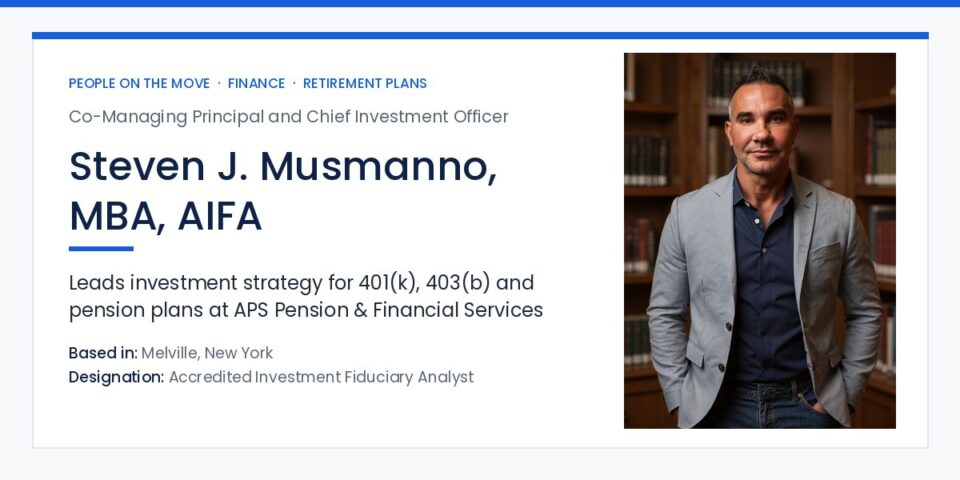
Co-Managing Principal and Chief Investment Officer
Steven J. Musmanno, MBA, AIFA
Based in: Melville, New York
Firm: APS Pension & Financial Services
Education: MBA in Finance, NYU Stern School of Business. Undergraduate degree, State University of New York at Oswego
Designation: Accredited Investment Fiduciary Analyst (AIFA)
Website: steven-musmanno.webflow.io
Most business owners pick a 401(k) provider once, sign the paperwork and rarely think about the plan again. Steven J. Musmanno spends his days on the part they tend to forget: which funds sit inside the plan, why they were chosen and whether they still deserve to be there.
Musmanno is Co-Managing Principal and Chief Investment Officer of APS Pension & Financial Services in Melville, New York, a firm that has designed, administered and invested retirement plans for closely held businesses for more than four decades. He also serves as Chief Investment Officer of APS Investment Management, the firm’s institutional fiduciary arm, and chairs its Fiduciary Investment Committee.
What a Chief Investment Officer Does for a Retirement Plan
At a firm like APS, the CIO role sits between the employer and the markets. Musmanno sets the asset allocation policy behind the firm’s risk-based portfolios, leads portfolio management and oversees day-to-day trading. Through the Fiduciary Investment Committee, investment decisions for institutional clients are reviewed and written down, which gives employers a record of how and why each choice was made.
The firm’s clients include private companies and nonprofit organizations with 401(k), 403(b) and defined benefit plans. The work covers writing investment policy statements, managing the funds offered to employees, building model portfolios and running independent fiduciary assessments of plans that are already in place.
Before APS, Musmanno worked at Merrill Lynch in New York City. He provided equity portfolio strategy to high-net-worth clients and later became Vice President of Institutional Research Marketing for the firm’s Emerging Markets Equity Research group. He holds an MBA in finance from NYU Stern School of Business and the Accredited Investment Fiduciary Analyst (AIFA) designation, which focuses on evaluating whether a plan’s investment process meets a defined standard of care.
Why Plan Oversight Has Become a Bigger Issue for Smaller Employers
Under the Employee Retirement Income Security Act, the federal law that governs most private-sector retirement plans, the people who run a plan are fiduciaries. They must act prudently and solely in the interest of participants. In 2015, the U.S. Supreme Court confirmed in Tibble v. Edison International that this includes a continuing duty to monitor plan investments, not just choose them once.
For years, lawsuits over high fees and weak fund lineups mostly targeted large corporate plans. More recent cases have reached mid-sized plans as well, and that has pushed many owners to ask who is actually watching their plan. Owners who follow small business coverage will recognize the pattern: a decision made years ago, never revisited, becomes a problem only when someone looks closely.
That is the gap firms like APS aim to fill. A documented review process does not guarantee results, and every investment carries risk, but it shows that the plan’s fiduciaries did their job.
A Plan That Works for the Owner, Too
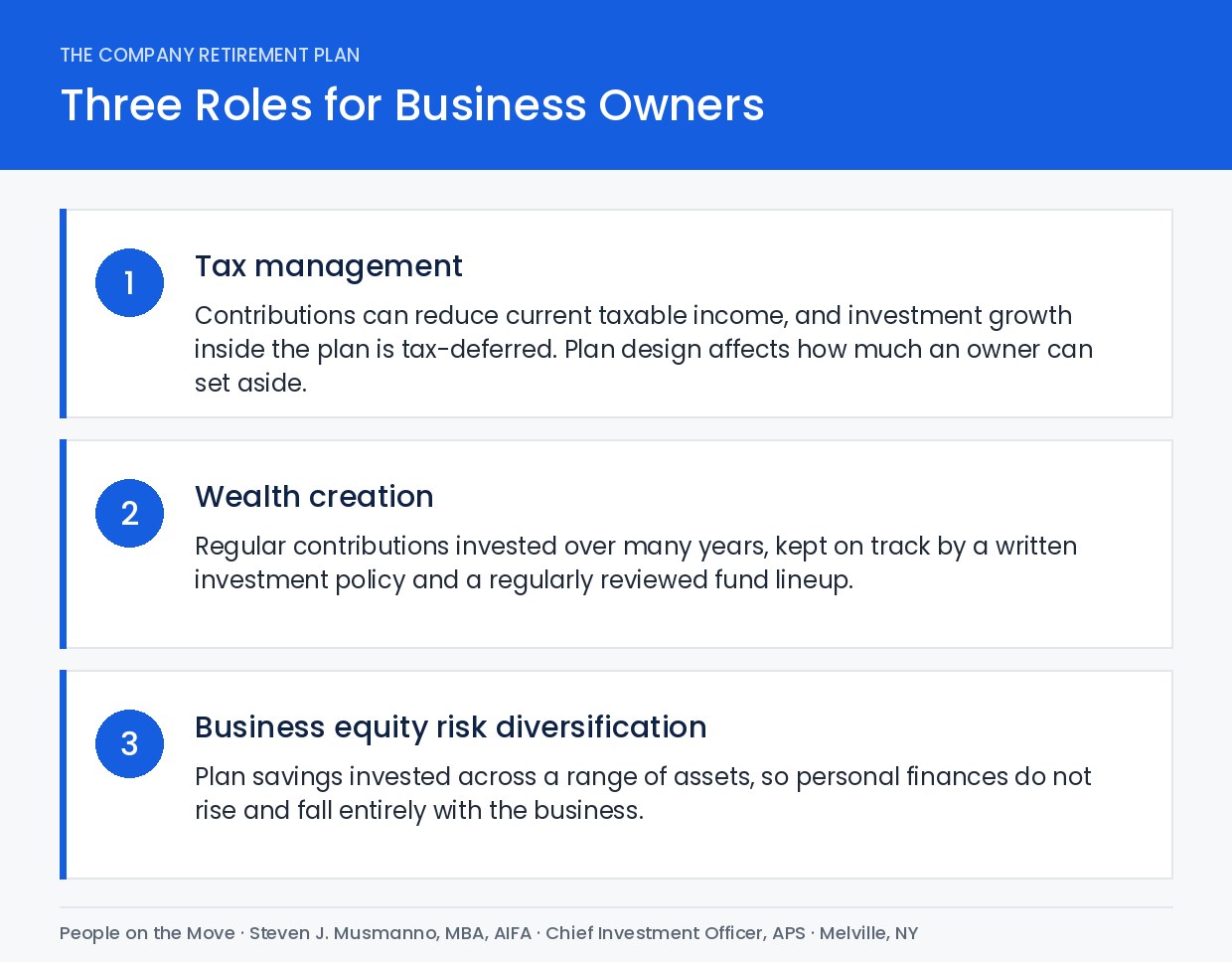
Musmanno approaches the company retirement plan as more than an employee benefit. For owners of closely held businesses, it can serve three purposes at once.
Tax management. Contributions to a qualified plan can reduce current taxable income, and growth inside the plan is tax-deferred. The type of plan and how employer contributions are structured affect how much an owner can set aside, which is why plan design and tax planning usually go together.
Wealth creation. Steady contributions invested over many years give savings time to grow. A written investment policy and a fund lineup that is reviewed on a schedule help keep that growth on a consistent track.
Diversifying away from the business. Many owners have most of their net worth tied up in the company they built. Retirement savings invested across a range of assets can spread that risk, so personal finances do not depend entirely on one business. Readers who follow finance coverage will recognize this as the same concentration risk that applies to any single holding.
Five Questions Owners Can Ask About Their Own Plan
An owner does not need investment training to check whether a plan is being looked after. These questions, drawn from the kind of review work APS describes, are a reasonable place to start.
- Do we have a written investment policy statement? It is not required by law, but it sets the rules for how funds are chosen, monitored and replaced.
- When were the plan’s funds last reviewed, and is there a record? Meeting notes or committee minutes show that monitoring actually happened.
- What are we paying, and to whom? Service providers must disclose their fees to plan sponsors. Someone should be comparing those numbers to what similar plans pay.
- Who is a fiduciary, and in what role? Some advisers share fiduciary responsibility for investment choices. Others only make recommendations. The contract should say which.
- Does the plan design still fit the business? A plan set up for a five-person company may not serve a fifty-person company well.
Outside the Office
Health and fitness are a large part of life for Musmanno and his family. He has run several marathons and half marathons, and the family supports the American Heart Association among other causes.
More profiles of executives and business owners are available in The Business Journal’s People on the Move section.
Steven J. Musmanno is an investment adviser representative of APS Wealth Management, LLC, an SEC registered investment adviser. Registration does not imply a certain level of skill or training. This article is for informational purposes only and is not investment, tax or legal advice.
For more announcements and local business coverage, visit The Business Journal’s Business News section.
